
After our previous drive of the Toyota Tundra, we were confident it would be a capable tow vehicle, so when the chance came to test it, we jumped at it.
A quick refresher on the Tundra, it is a full-size American pick-up, proudly built in Texas!, powered by a 3.5-litre twin-turbo V6 petrol-electric hybrid, producing 326kW and 790Nm.
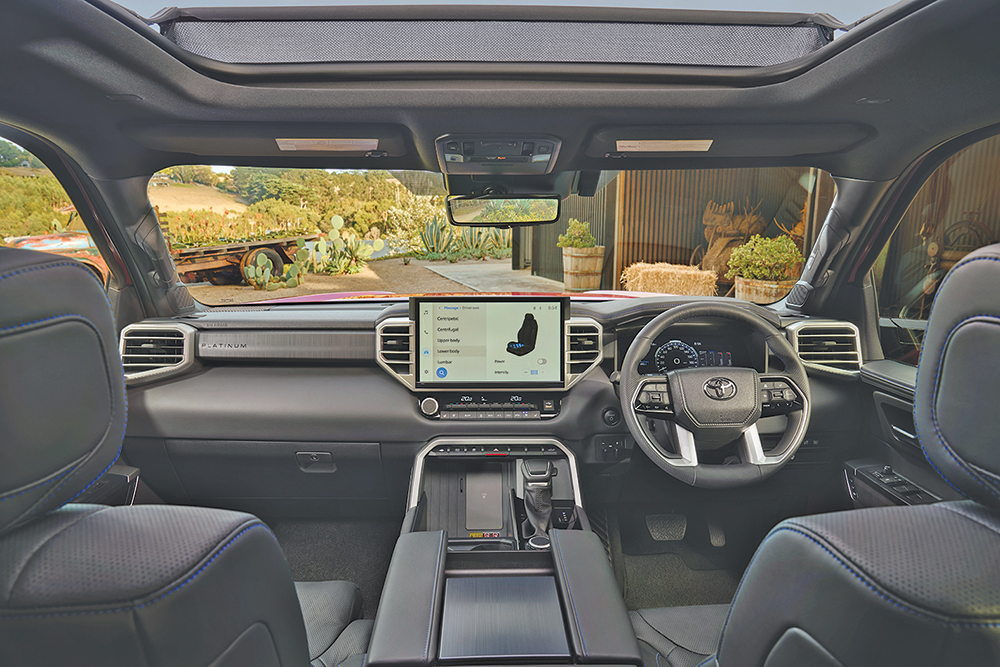
Our test car was the Platinum specification, which meant it got all the goodies, including heated and cooled seats front and rear, the fronts also had multi-mode massage function.
Returning after a few months away, the seats weren’t as all-encompassing as I remembered, they felt a little flat with not a lot of bolstering, but half an hour later, I was right at home.
No surprise, there was plenty of head, leg and shoulder room, the electrically adjustable steering wheel had plenty of scope for height and reach.
Priced north of $180,000, the Platinum has literally everything that opens and shuts, including remote operation of the tailgate, clearly those Good Ol’ Boys aren’t big on doing it themselves.

The Tundra is smaller than other US-sourced pick-ups now available here, but still outsizes popular models including the HiLux and Ranger.
It is a long way up even for normal-sized people, but once you are up there, it is a commanding position offering plenty of vision, except for the immediate rear, but more on that later.
With enough power to pull a house off its stumps, the next challenge is putting it to work, cue the 10-speed automatic.
As well as a gear for every occasion, the transmission has a tow-haul mode, compensating for the extra weight out back and smoothing starts and gearshifts, reducing driveline shock under acceleration.
There is also four-wheel-drive, high and low ranges, although the standard 265/60R20 road-biased tyres will struggle for grip in loose surfaces.
While the Tundra has a tow rating of 4.5 tonnes, it comes at a cost, with the Platinum only taking 704kg in payload, despite the massive tub.
The task at hand was helping a friend move farms, including machinery and implements with a number of loads passing the 3.5-tonne limit of most utes.
Despite the imposing dimensions, hitching the trailer was simple, thanks to the standard reversing camera.
Mounted in the tailgate at a 45 degree angle, it avoids distortion, allowing you to roll under the tow hitch first time, every time. Some might call it cheating, but if the technology works, why not use it?
My favourite part was the bumper-mounted plug, no reaching underneath to find the installer hidden behind the mounting, just walk up and plug it in, attach the safety chains, check lights, a tug test and it is set.
This is where the endless power of the V35A engine kicks in, a gentle application of the throttle takes up the slack and we are good to go.
As a truck journalist, I have tested everything up to triple trailer road trains, this isn’t in that class, but it is a big unit, something causing concern in the heavy transport community is inexperienced drivers taking long, heavy, combinations without any specialised training or licence testing.
With an all-up weight around seven tonnes and a measuring around 11 metres long, this was borderline light rigid truck territory, yet it can be driven on a car licence.
The first adjustment is the length, requiring extra caution when merging, as well as co-operation of other drivers to understand you are taking up more space than a standard car.
The Tundra powered through the low gears effortlessly, we were up to 100km/h in about 15 seconds, the twin turbo V6 rumble reverberating around the cabin.
A couple of thumb pushes engaged cruise control, the computers taking care of maintaining our speed, I set my limit 1-2 km/h under the posted maximum, it gives an extra moment to react as well as encouraging other drivers to pass and give me a clear road.
Our highway run included a number of steady climbs, which the Tundra barely noticed, we felt a minor drop in road speed as they steepened, it just went back to 8th gear and applied the power, the rumble increasing as the revs built and we were quickly back to speed.
One downside to enjoying the throaty V6 burble was the fuel consumption, this is a big car with an equally big thirst, our average on a flat road, cruising at around 108km/h, was 17 litres/100 kilometres, blowing out to over 19 litres/100 kilometres in the hills.
This compares to the 12-13 litres/100 kilometres we recorded during previous testing over similar terrain without a trailer weighing us down.
Toyota gave the Tundra braking power to match the pulling power, the cruise control used a combination of engine braking – dropping down two or three gears before applying the wheel and trailer brakes.
We avoided heavy braking, never a good idea when towing a trailer or a caravan, instead going for steadier applications of longer durations, rather than short sharp hits, allowing the Tundra’s four wheel discs – 354mm front and 335mm rear – to bring the speed down.
We didn’t need the trailer sway control, part of the standard safety systems, hopefully as much due to our good driving as the Toyota technology.
Cross winds weren’t a big issue, the combination of our high gross weights and the trailer’s low profile kept us on the straight and narrow.
The Tundra proved a stable platform and an excellent tow vehicle, firmly planted on the road, comfortably dealing with the vagaries of New South Wales’ rural road network, displaying impeccable road manners.
This very capability could prove its Achilles’ Heel, it was so effortless it can lull unwary drivers into a false sense of security.
There is a school of thought that if you are constantly fighting the vehicle you are more vigilant and less likely to make a mistake.
I prefer a vehicle that allows me to relax into the driving.
The $180,000 and more price tag is an obstacle to ownership, no argument, but if you have the means, and tow long and heavy, it is hard to top the Tundra.