
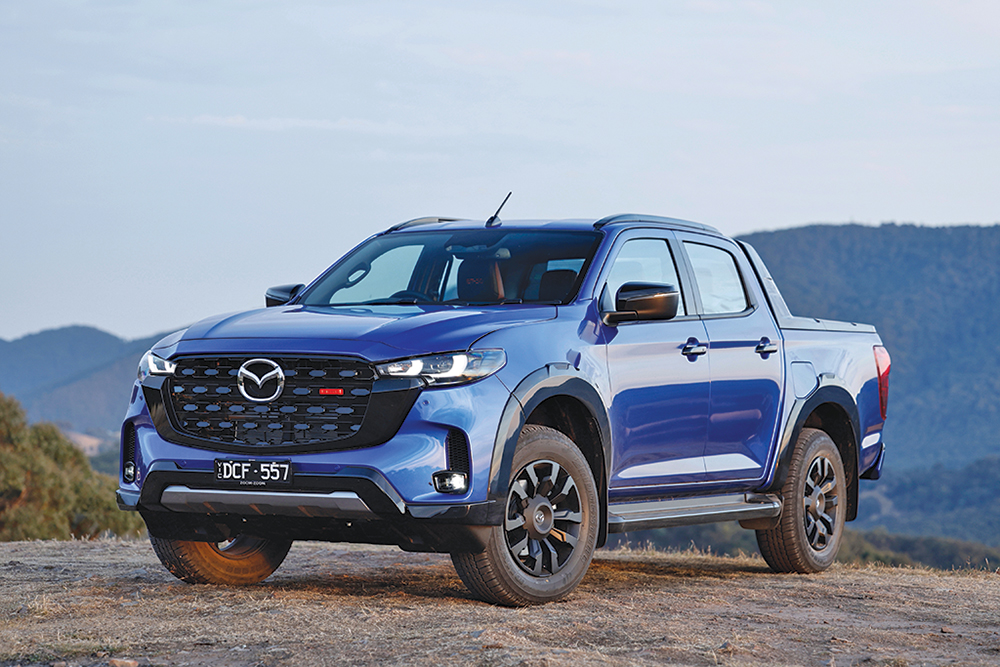
After decades of service, wearing a variety badges, Mazda’s Isuzu-sourced BT-50 is undergoing a big change, the likely end of the 3-litre engine and the arrival of a new 2.2-litre unit.
Mazda chose to drop their own light commercial range to focus more on the CX range of SUVs, instead badge engineering the popular and robust Isuzu D-Max ute into the BT-50 role.
Powered by the iconic 4JJ 3-litre, four cylinder, turbodiesel, backed by a six-speed auto, the BT-50/D-Max has a well-earned reputation for ruggedness and reliability.
Sadly for fans of the 4JJ, myself included as a former owner, the engine is approaching the end of its lifecycle, as global regulations demand greater efficiency.
So, when Mazda offered a drive of the 3-litre, I said yes, especially since it dovetailed into a couple of motorsport events, allowing a test of its towing ability one more time.
Our test car was the top-spec SP edition, adding lots of gloss black – 18” rims, sailplane sportsbar, wheel arch extensions, roof rails, door mirrors and grille, plus a manually operated roller shutter tonneau cover.
The rest of the car is standard, Mazda’s familiar vertical drop grille ‘face’, swept back slimline headlights and high bumper line front and rear.
In that respect, there is not much to add, the basic body shape remains, typical three-box design, one for the engine bay, the bonnet sloping gently upwards to the windscreen, a bigger one for the cabin and a giant tub out the back.
The window line is high, there is more door than glass, it avoids claustrophobia, although the rear seat view is reduced by the upswept door trim.
I know sports bars looks good, but are form over function, especially with the roller cover, restricting your ability to reach into the back, especially around the headboard.
My choice would be keep the shutter but lose the bar, I prefer load security over looks.
The rear bumper has a wide cut out step to access the tub over the tailgate, using the sidesteps to reach into the front of the tub.
The slow-drop tailgate is heavy, it can be closed single-handed, maybe a couple of gym sessions would help – or perhaps 30 tailgate closes might qualify as a workout?
Although practical, the sidesteps impact the breakover angle, regular offroaders might consider a ‘delete option’ request.
Otherwise, the underbody is tidy, no low slung exhaust or suspension to get hung up on obstacles makes the BT a good choice for offroad work.
While our test car looked good in Geode White Pearl, with a nice glow in direct sunlight, my personal favourite is the Red Earth metallic, it suits the BT shape.
Inside, there is no choice, the SP gets an attractive mix of black and terracotta leather, with Maztex accents on high wear areas.
Seats are comfortable, wide enough to hold a range of body sizes and shapes, offering plenty of support despite looking a little flat.
As the top spec, the SP gets everything Mazda has to offer, although don’t expect CX Azami levels of niceness.
This means heated front seats, powered for the driver, a 9-inch central touchscreen and dual zone automatic climate control.
Not the longest list, but decent for what is essentially an upgraded work truck, you want ultra luxury, then one of the big SUVs is the way to go.
Accepting this, the interior is comfortable while retaining practicality, unlike others that try to be off-road limousines.
Entry and exit was easy, the raised ride of the 18” rims put the seats at the right height to slide in and out, shorter passengers used the grab handles and side steps in their quest to reach the summit.
The infotainment system includes AM/FM/DAB, CarPlay and Android Auto, all major entertainment options are covered, it doesn’t have a bespoke 14-speaker sound system, but in a couple of thousand kilometres over two weeks, we had no complaints.
That is the BT-50’s secret, it is happy in its skin, doing what it was designed to do, carry loads and cover distance.
The BT-50 is not a 500hp monster, wheelstanding at the slightest provocation, this is WYSIWIG motoring – what you see is what you get – in this case 142kW and 450Nm, delivered in a lazy, last forever, way.
People either love or hate the 4JJ, there aren’t many haters, it is a slow, deliberate engine that has the runs on the board for longevity.
What it teaches you is to plan ahead and be aware of what is happening around you, as well as 500 metres away.
This motor defines ‘heavy duty’, others claim it, but the 4JJ owns it, you don’t quite measure acceleration with a calendar, but I wouldn’t be entering the SMP diesel drags either.
Given we were towing the GemRod – also Isuzu powered! – to and from racetracks, including spares, tools and fuel, it was perfect.
The slow-revving nature of the engine allowed the standard fit tow hitch to take up the strain progressively, no sudden lurching or snatching under power.
Building up a head of steam, the engine settles into a steady ‘thrum’ and chugs along, the little engine that can, and does.
Hills were dispatched with ease, the 6-speed automatic dropping a gear or two, depending on the gradient, and we continued our stately progress.
The steering is well-weighted and accurate, not MX-5 sharp, perfect for a heavily laden ute pulling a trailer, changing lanes in an 11-metre plus combination.
There was plenty of assistance, especially at low speed, but it wasn’t trying to turn itself, or the trailer, inside out.
Brakes were similar, there was plenty of retardation but a slightly relaxed brake pedal meant there were no locked brakes while pulling up five tonnes of ute and trailer.
The BT-50 was an ideal tow vehicle, comfortable and capable.
Would I have one? Well, in a previous iteration, I did, and one of my sons bought two, this is for those who put ability and capability at the top of their list.
