
Few cars conjure images of speed, power and freedom like the Ford Mustang, an enduring and iconic nameplate proudly celebrating more than 60 years in the market.
Despite its global recognition, the majority of Mustangs are sold in the North American markets. Australia received a small batch after they were launched, with a similarly small number sold here in the early 2000s.
Fast forward to 2015 and the Mustang became a fully-fledged factory right-hand drive car, and Australian buyers were lined up, ready to place orders.
While the iconic V8 Mustang remains the cornerstone of sales, Ford offers the EcoBoost, a 2.3-litre four cylinder turbo model.
Although it flies (gallops?) under the radar for many, the turbo option has its own fan base, loyal to the smaller engine.
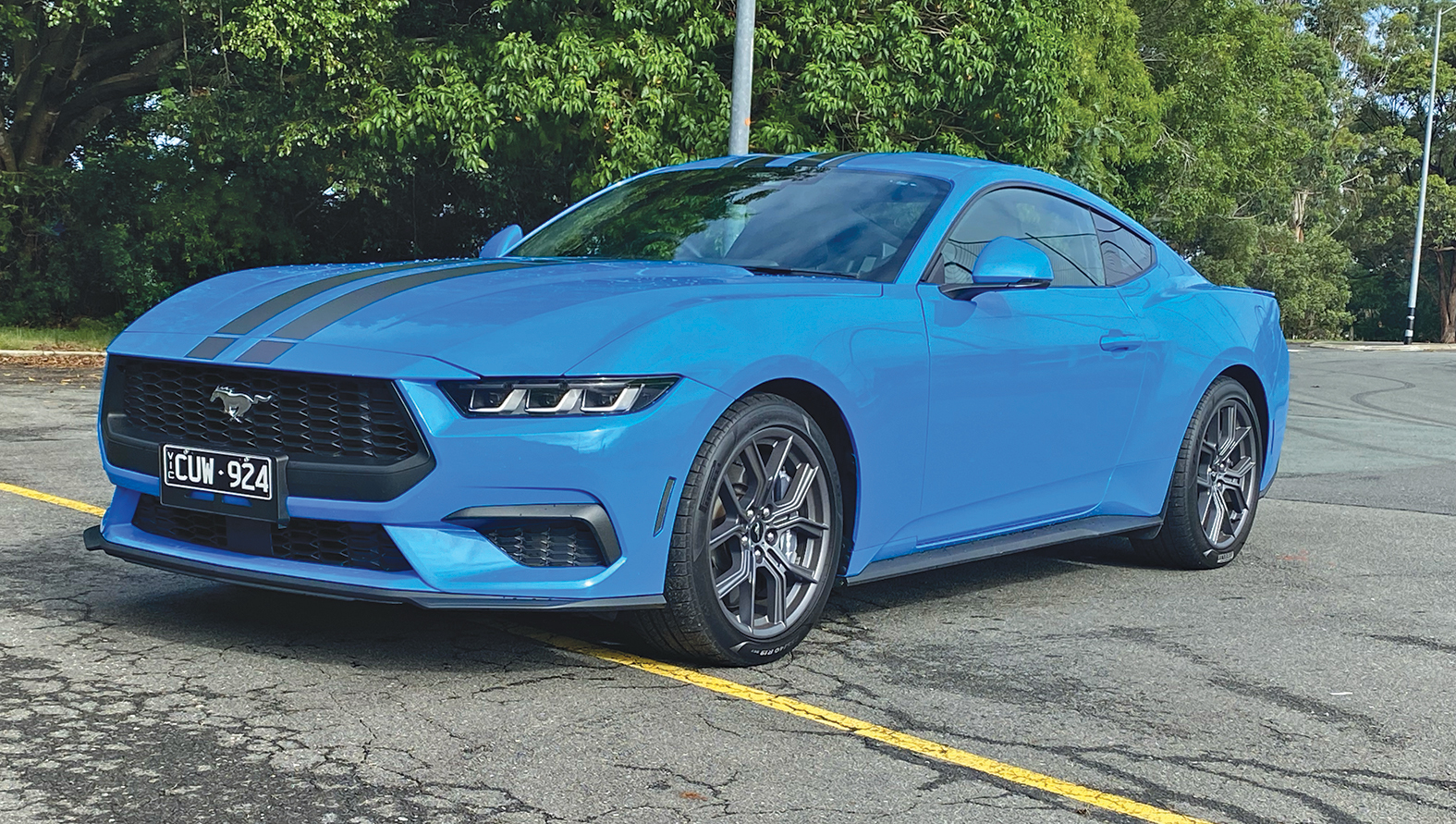
Thus, it came to pass that a Grabber Blue EcoBoost landed in the driveway for a week, reminding all who rode along it is as much a thoroughbred as its more recognised stablemate.
With its instantly recognisable profile, the EcoBoost is every inch (sorry, metric doesn’t work) a Mustang, from the long nose/short boot profile to the triple vertical tail lights.
In between is the low slung, curved, roof fastback cabin, l-o-n-g doors, and of course the overhung nose cone and recessed grille.
Throw in a dual-plane front spoiler and discreet bootlip-mounted rear wing – the most subtle part of the car – and the look is complete.
Inside, the Mustang is thoroughly 21st Century, with all the expected fruit – dual zone climate control, touch screen infotainment and a cornucopia of buttons, on the dash and the steering wheel, controlling every aspect of the car.
My favourite is the ‘Mustang’ tab, providing a window into the heart and soul of the car, allowing full personalisation, including steering response, exhaust valving and launch control options.
Bang & Olufsen audio fills the surprisingly spacious cabin with sound, smooth and without echo, boosted by the enormous boot-mounted subwoofer.
The electronic park brake looks traditional, but is a spring-loaded dual function switch, engage drift mode and it is a rally-style ‘hold and release’ unit, allowing the rear to slide across loose surfaces.
Powered, leather-clad, heated and cooled front seats are big, I felt right at home, with plenty of leg, shoulder and headroom, and the big footrest was perfect for my size 12s.
While there are two rear seats, they are for little people, a 170cm friend tried them and found his head touching the rear window.
I love the chunky D-shape steering wheel, big thumb rests position your hands at nine and three for optimal control and access to the nine-a-side buttons.
There are electronic paddle shifts for manual gear changes, one complaint was the generic indicator and washer/wiper stalks, looking like old Focus units, surely a sexier version is available?
The big red button for engine start betrays the left-hand drive design, it is a long reach to the passenger side, same as the bonnet release.
The dash is digital, with multiple driver-selectable options, from classic twin dials to race-themed views.
With that long bonnet and floor level seating don’t expect great vision of the nose, especially the front splitter, when parking, make full use of the camera and sensors until you have learned the limits.
Despite the low seats, entry and exit is good, the big doors open wide, just give yourself swing room in car parks, to avoid getting wedged in.
The best part of getting in and out? Unlocking the doors and puddle lights in the door mirrors project the galloping Mustang logo on the ground, reminding everyone what they are looking at!
All-round vision is better than expected from the low curving roofline and sloping rear window, I had no problem, and the blind spot monitors pick up anyone playing hide and seek in traffic.

Time to rip the Band-aid off, yes, this Mustang is a four-cylinder turbo, backed by a 10-speed automatic, the twin scroll turbo delivers 232kW, arriving in a thunderous rush, especially in full race mode.
Casual bystanders said it was a V8, based on the aural output, unlike most turbo cars the pure engine noise is given full voice, not muted or dulled by the turbine.
Engage race modes – drift, drag or circuit – and the engine spools up, with launch control unleashing the power to fire you down the road.
We found a reluctance to fast shifts, despite paddling for the next gear, it lacked the instant response of an automated manual.
Similarly, downshifts were delayed, as though the computer was holding the gear until road speed was lower, perhaps to prevent compression locking the driveline, but it reduced engine braking and left you second guessing shifts entering corners, not a good feeling.
Mandatory driver aids also made their presence felt, while steering modes could be selected, even in race mode, when driving lines are more aggressive, there was steering push back if we touched a lane marker.
It created a notchy feel, rather than the smooth, progressive, steering you want when hammering hard through corners.
The good news is the massive Brembo brakes are up to the job, whether it is idling through traffic or desperation braking into a corner, the Mustang pulled up hard every time, inspiring confidence.
While it lacks the polish of other performance cars, it is this ‘rough diamond’ feel that is the Mustang’s appeal.
There is a level of silly cool about it that makes you smile every time you see it.
No, it is not the most practical of cars, restricted forward vision makes parking an adventure, although the boot is huge, but it remains true to the ideals of fun and freedom that drove its creation in 1964. ‘Fun, Fun, Fun’ might have been written about a Thunderbird, but as a theme song, it feels right for the Mustang.