
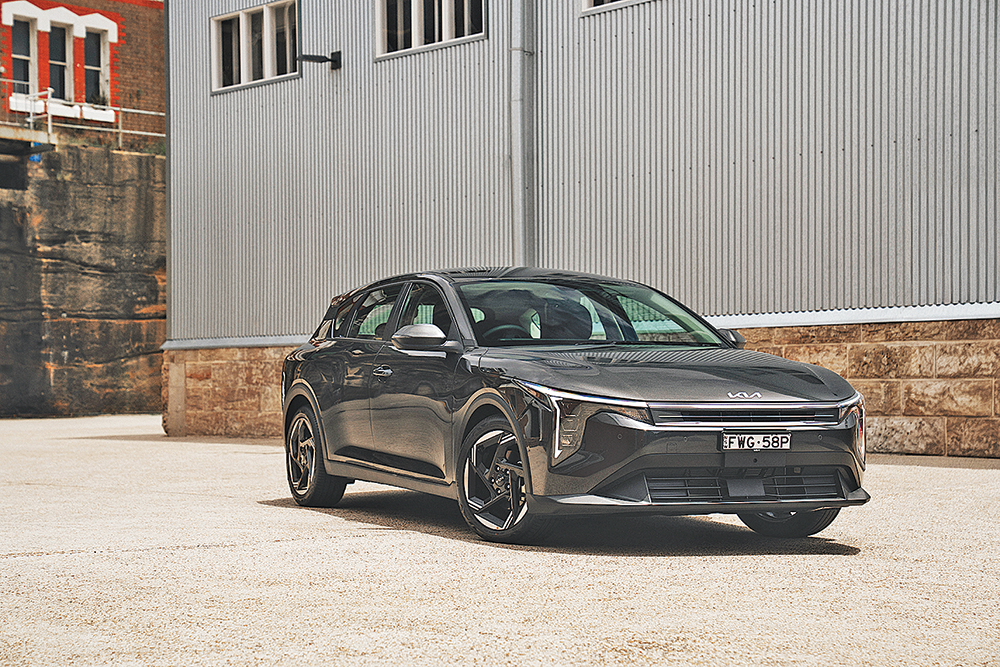
In an interesting move, KIA ditched the previously popular Cerato name as part of a model upgrade, instead revealing the K4 as its small-medium passenger car competitor.
At first glance, it looks like a long wheelbase Stonic, with the same ‘Tiger Face’ family front, looking less of a blunt object than its smaller sibling.
The bonnet leading edge slopes down with a slimline bumper bisecting the air intake, the main section angles upwards from the chin spoiler.
The bonnet scallops are less aggressive on the K4, air still channels rearwards around the body colour door mirrors, but with fewer body pressings.
Guards are mildly pumped, sitting slightly proud of the doors, creating a squat, purposeful profile, I like the long roofline of the hatch, our test car was the mid-spec ‘Sport’, which looked good in Aurora Black, with only minimal chrome and bling.
The tailgate opens to horizontal, I had to duck to clear it, but the cargo area is deep, with a recessed floor well below the bumper lip height, making it a really usable space.
That is the K4’s strength, it is a solid, good looking and eminently practical design, a case of form and function coming together in the single package.
Inside, the K4 is a story of practical comfort, everything is there for a reason, with minimal window dressing.
Cloth-trimmed seats are firmly padded, but not uncomfortable, you find yourself settling into them the longer you drive, with good foam compression when needed.
Sadly, we didn’t get heated seats or steering wheel, but the dual-zone climate control worked well as the outside temperatures fell.
With no sunroof, the interior space was voluminous, head, leg and shoulder room was excellent, with no rubbing of elbows.
The flat-top and bottom steering wheel is a monochrome black vinyl in the Sport, it was thick enough for me without being too cumbersome for my partner.
She had one complaint, the doors opened too wide and she struggled to pull it closed once she was seated, for me, it was nice to have a large door opening for ease of entry and exit.
The ‘Integrated Panoramic Display’ – also known as the widescreen infotainment and instrument screen – is clear and easy to read, there is a 5” climate control panel separating the two 12.3” main displays.
A row of buttons below provide access to the main functions, with a horizontal roller controlling audio volume.
The infotainment, with inbuilt maps and telephony and main vehicle systems, also supports wireless CarPlay and Android, as well as AM/FM/DAB, playing through a six-speaker sound system.
The instrument panel is easily read through the two-spoke steering wheel, driver selectable displays giving a choice of readouts.
Buttons on the steering wheel face control the usual functions of telephone, cruise and volume, as well as accessing vehicle information.

The t-bar shifter falls to hand nicely, not that you use it much, with big cupholders separating it from a deep central storage box.
Like the exterior, the interior just does its job, there is no fuss or fanfare, if you need it, you will find it, if you can’t find it you probably don’t really need it.
Power for the K4 Sport is a 2-litre, four cylinder petrol engine delivering a solid, but unspectacular, 110kW/180Nm driving through a continuously variable transmission (CVT).
For me, this is both a benefit and a drawback, one of my first drives was an 80 kilometre jaunt up the motorway, and it was sheer joy.
The CVT settled into its rhythm, engine speed barely fluctuating as the transmission bands constantly adjusted to match the ideal engine speed to the road speed.
The downside was arriving at our destination, we were back in stop-start traffic, and the CVT’s expected weak spot was revealed, those minor band adjustments that make it a perfect cruising option became major events as it tried to keep up with constant speed changes.
Where the driver can see what is happening and make pre-emptive choices to accelerate or brake, matching the speed of surrounding traffic, the CVT has no clue what is happening and can only react to driver inputs.
The result is the transmission is always a fraction of a second behind, playing catch up to the driver’s requests, often manifesting as the driver pressing the accelerator, spiking the engine revs, while the CVT tries to resize the pulleys to meet demand.
To be fair to KIA, this is an issue with all CVTs, and it is a result of manufacturers needing to meet government-imposed regulations demanding cars be increasingly efficient, travelling further while consuming less.
This is where CVTs shine, long, constant-speed trips using less fuel than traditional transmissions, the flipside is stop-start traffic where the CVT is constantly trying to meet demands, those repeated engine over-speeds cause increased fuel burn.
That aside, the K4 is a good drive, with a well-sprung and compliant suspension able to deal with the trials and tribulations of Australian roads.
It is not a racer, and it doesn’t try to be one, instead it is a capable town car that loves long drives in the country.
You hear the bumps and thumps underneath you, but it is a remote, distant, sound, isolated from the cabin.
The steering is accurate, but not fast, the nose goes where you want, but without the razor sharpness of a sports car.
Modern electric power steering is a delight, the K4 has minimal ‘wander’ at the straight ahead position, tracking accurately down the road, as well as reducing driver fatigue because you aren’t constantly adjusting the steering by not drawing engine power, it also helps reduce fuel consumption.
What you get is a relaxed driving experience, even with the CVT always feeling a step behind in stop-start traffic.
The biggest frustration is the ‘3,2,1…Go’ feeling, you have to pre-plan your moves to ensure the transmission is on the same page when it comes to snagging that break in peak hour traffic.
Despite this, I enjoyed the K4, in every other aspect it was a pleasant experience, practical and comfortable. It is a kind of ‘Goldilocks’ car, not too hot, not too cold, not too hard, not too soft, if you want a competent all-rounder, I recommend a closer look.